You open a message and see “DPWM.” No clue what it means. You pause, reread, and still nothing makes sense. Is it rude? Is it a joke? Did you miss something?
That’s exactly why so many people search for DPWM meaning in text. New slang shows up fast, especially in chats, gaming, and social apps. One small phrase can change the tone of a whole conversation.
This guide breaks it all down in simple words. You’ll learn what DPWM means, how people use it, when it’s okay to say it, and how to reply without sounding confused. No guesswork. No awkward replies. Just clear answers you can use right away.
What Does “DPWM” Mean in Text?
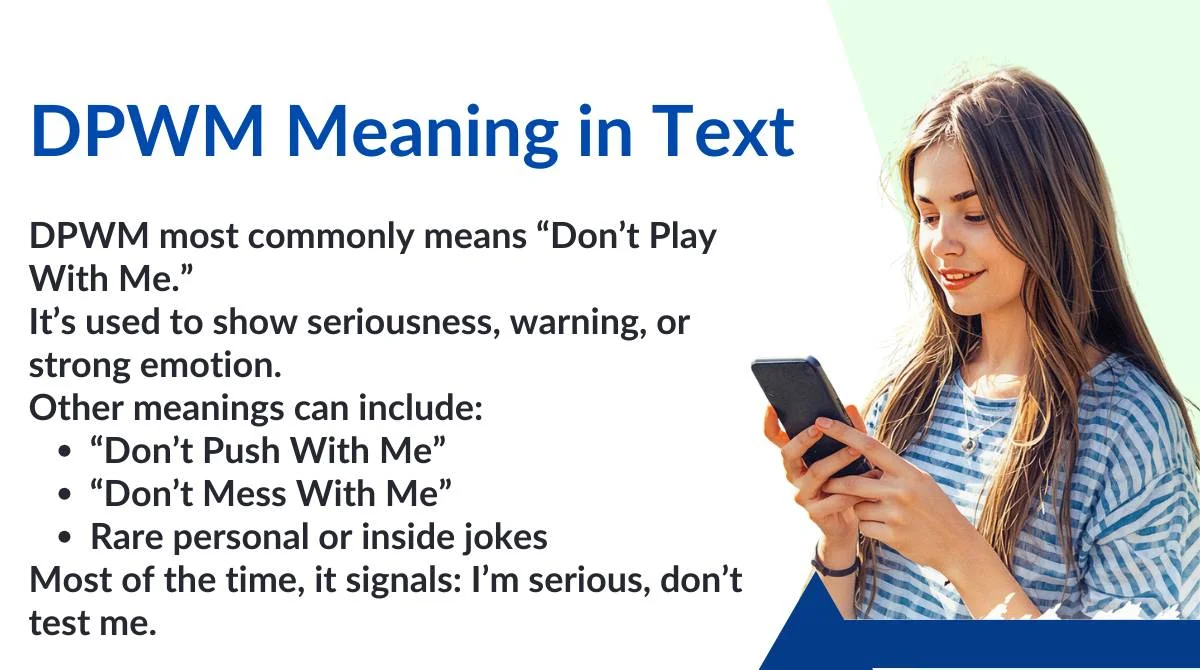
DPWM most commonly means “Don’t Play With Me.”
It’s used to show seriousness, warning, or strong emotion.
Other meanings can include:
- “Don’t Push With Me”
- “Don’t Mess With Me”
- Rare personal or inside jokes
Most of the time, it signals: I’m serious, don’t test me.
The Most Common Meanings of “DPWM”
1. Don’t Play With Me (Most Used)
This is the main meaning. It shows someone is not joking anymore.
When it’s used:
- When someone feels disrespected
- When jokes go too far
- When someone wants to be taken seriously
Examples:
- “I told you already, DPWM.”
- “Stop joking, DPWM.”
Tone: Serious, sometimes slightly aggressive.
2. Don’t Mess With Me
Very close to the main meaning but stronger.
When it’s used:
- In arguments
- When setting boundaries
- When warning someone
Examples:
- “You better chill, DPWM.”
- “I’m not the one, DPWM.”
Tone: More intense and confrontational.
3. Playful but Serious (Mixed Tone)
Sometimes DPWM is used in a joking way, but with a hint of truth.
When it’s used:
- Between close friends
- In teasing situations
- In playful arguments
Examples:
- “You ate my fries? DPWM.”
- “You really forgot again? DPWM lol”
Tone: Light, but still shows mild annoyance.
4. Inside Meaning (Rare Cases)
Some groups create their own meaning for DPWM.
When it’s used:
- Private chats
- Friend groups
- Gaming teams
Example:
- “DPWM tonight?” (might mean something unique in that group)
Always check context.
How “DPWM” Is Used in Real Conversations
Friends & Casual Texting
Among friends, DPWM is common and flexible.
It can mean:
- “I’m serious”
- “Stop joking”
- “You’re pushing it”
Example:
- Friend: “I’m taking your hoodie.”
- You: “DPWM, give it back.”
Here, it’s not aggressive. Just playful control.
Instagram & Snapchat
On social apps, tone matters a lot. DPWM is often used for reactions.
Common uses:
- Replying to stories
- Commenting on posts
- Reacting to drama
Example:
- “You really posted that? DPWM.”
It can feel bold or dramatic depending on the vibe.
Dating Apps
Here, DPWM can change meaning fast.
Positive use:
- “You didn’t text me back? DPWM.” (flirty tone)
Negative use:
- “Don’t waste my time, DPWM.”
Tone depends on relationship level.
If used too early, it may feel intense.
Gaming & Online Communities
In games, DPWM is often competitive.
Used when:
- Challenging someone
- Responding to trash talk
- Showing confidence
Example:
- “You think you can win? DPWM.”
Tone: Competitive, bold, sometimes aggressive.
Work or Professional Chat
DPWM is not suitable here.
Using it at work can:
- Sound rude
- Look unprofessional
- Create tension
Example (bad use):
- “Finish it today, DPWM.”
Avoid it in emails, Slack, or formal chats.
Is “DPWM” Rude, Flirty, or Offensive?
DPWM is all about tone and context.
When It Feels Rude
- During arguments
- With people you don’t know well
- When said without humor
Example:
- “I said no, DPWM.”
This feels harsh and direct.
When It Feels Flirty
- Between people who already have chemistry
- When paired with jokes or emojis (outside this article)
Example:
- “You forgot me? DPWM.”
This can feel playful and teasing.
When It Feels Neutral
- Among close friends
- In casual joking
Example:
- “DPWM, you know I’m right.”
No harm, just expression.
Psychology Behind It
DPWM works because it sets a boundary fast.
It signals:
- Confidence
- Frustration
- Control
But it can also:
- Push people away
- Start conflict
So it’s powerful but risky.
How to Respond When Someone Says “DPWM”
Your reply should match the tone.
Casual Replies
- “Relax, I’m just joking.”
- “Alright, chill.”
- “Okay, I hear you.”
Funny Replies
- “Too late, already played.”
- “Can’t stop, won’t stop.”
- “Oops, my bad.”
Use these only if the vibe is light.
Neutral Replies
- “Got it.”
- “Understood.”
- “Okay.”
Safe and simple.
Professional Replies
If someone uses it in a work setting:
- “Let’s keep this respectful.”
- “I understand your point.”
- “Let’s focus on the task.”
Stay calm and clear.
Common Misunderstandings About “DPWM”
1. Thinking It Always Means Anger
Not true. It can be playful too.
2. Confusing It With Random Acronyms
Some people think DPWM means something technical. It usually doesn’t.
3. Assuming It’s Always Rude
Tone depends on relationship and context.
4. Ignoring Context
Same phrase, different meaning depending on situation.
5. Using It Too Soon
Using DPWM with strangers can feel aggressive.
Similar Slang Terms You Should Know
- FAFO – Actions have consequences
- IDK – I don’t know
- TBH – To be honest
- SMH – Disappointment or disbelief
- FR – For real
- ONG – I swear or serious
- BET – Agreement or approval
- NO CAP – No lie
- LOWKEY – Slightly or secretly
- HIGHKEY – Obviously or strongly
- WYD – What are you doing
- IMO – In my opinion
These often appear in the same chats as DPWM.
When You Should Avoid Using “DPWM”
Professional Settings
Avoid in:
- Emails
- Meetings
- Work chats
It sounds too direct and informal.
Cross-Cultural Chats
Not everyone understands slang.
It can confuse or offend people from different backgrounds.
Sensitive Situations
Avoid when:
- Someone is upset
- Serious topics are discussed
- Emotions are high
It may escalate things.
New Relationships
Using DPWM too early can:
- Feel aggressive
- Create distance
Better to keep tone soft first.
FAQs
What does DPWM stand for in texting?
It usually means “Don’t Play With Me,” showing seriousness or warning.
Is DPWM rude?
It can be, depending on tone and context. With friends, it may be playful.
Can DPWM be flirty?
Yes, in casual or dating contexts it can be teasing and playful.
Where is DPWM most commonly used?
In texting, social media, gaming chats, and casual conversations.
Should I use DPWM at work?
No. It’s too informal and may seem rude.
How do I know what DPWM means in a message?
Check the tone, relationship, and situation. Context decides meaning.
What should I reply to DPWM?
Match the tone. Stay calm if serious, or joke if the vibe is light.
Conclusion
DPWM is a short phrase with strong impact. Most of the time, it means “Don’t Play With Me,” but the real meaning depends on tone, context, and relationship.
Used right, it can be funny, confident, or expressive. Used wrong, it can feel rude or aggressive.
The key is simple: read the situation before you react. If you understand the vibe, you’ll always know what DPWM means—and how to respond without confusion.